FOXYPICK STORIES / FOUNDER 001 / FIRSTHAND EXPERIENCE

We ordered 100 wall panels from China.
Then 76 sold in 48 hours.

After five unsuccessful business attempts, a wall in our new Phoenix home led me to Alibaba, a nervous first wire transfer, a garage full of inventory, and a business I never expected to build.

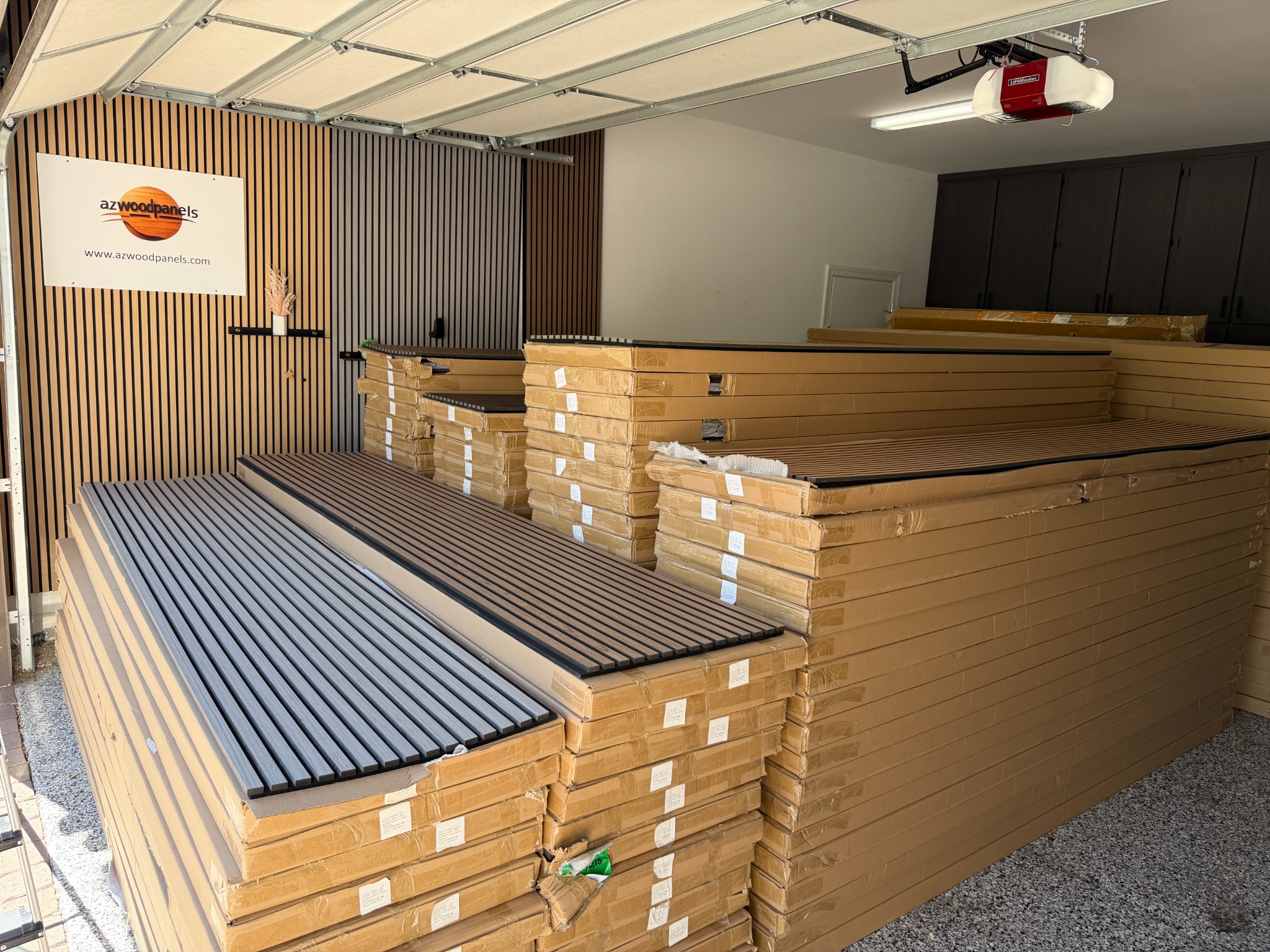
Authentic AZ Wood Panels Phoenix garage stacked with boxed 10-foot acoustic slat wood wall panels ready for local customers
The business began in a garage. Actual AZ Wood Panels acoustic slat wood wall panel inventory, photographed in Phoenix.
BY DAN M. · FIRSTHAND FOUNDER STORY

Dan founded AZ Wood Panels in Phoenix and documents his own importing, storage, sales and installation experiences. Business claims are founder-reported, not independently audited. Meet the founder and read disclosures →

About this case study: This is the personal account of the founder of AZ Wood Panels, which they own and operate. It is not an independent evaluation of that business or its competitors. Prices mentioned are the founder's recollection from the time, not a current verified retail comparison. Business profitability figures are not published here because the full cost and income records have not yet been reconciled.

THE STORY IN SIX MOMENTS

From an idea to a real importing business

01The problemWe wanted roughly ten 10-foot wall panels for our new home.
02The first orderA supplier minimum of 100 panels turned our purchase into an experiment.
0348 daysThe shipment arrived after an international wire transfer.
0476 in 48 hoursOur Marketplace listing showed unexpected local demand.
05Services expandA local contractor found us on Google and became an installation partner.
06Scaling upWe planned our largest shipment yet: approximately 1,035 panels.

I'd tried at least five businesses. Then our new house changed everything.

I've always wanted to be an entrepreneur. I love finding products, trying new technology, and exploring whether an idea could become a business. But wanting to start something and finding an idea that actually takes off are two different things. I'd tried at least five businesses without getting the traction I hoped for.

About twelve months ago, my wife and I were furnishing our new house in Phoenix, Arizona. She was shopping for acoustic slat wood panels for an accent wall. We have 10-foot ceilings, so we wanted extra-large panels—roughly 10 feet tall and two feet wide—rather than shorter pieces with visible seams.

We browsed options from Wood Veneer Hub, Panel Decor Hub, WoodUpp, and Aku Woodpanel. For the large panels we wanted, I remember seeing prices around $250–$350 apiece. We needed about ten panels. I couldn't stop thinking about how expensive that one wall would be.

I found a factory—but the minimum was 100 panels.

I'd heard about Alibaba from friends and family, but I had never placed an order there. I was skeptical about buying directly from a Chinese factory I'd never visited. Still, I contacted several manufacturers of acoustic slat wall panels through the platform and found one with the color my wife and I wanted.

The manufacturer's price seemed attractive, even once we included shipping to Phoenix. The catch was the quantity. We needed ten panels; the factory wanted us to buy 100.

My wife and I decided to think about it differently: install ten in our own home, then attempt to sell the remaining inventory locally. If enough people wanted them, we might recover the cost of our wall and perhaps earn some extra money. We had no guarantee that would happen.

The wire transfer was the scary part.

We had only spoken to the supplier through online messages. Sending an international wire to a person we'd never met made me nervous. What if the panels didn't arrive? What if the color or quality was wrong? We decided to take the risk and sent the money.

Exactly 48 days after the wire transfer, the panels reached our home. The delivery was enormous for a residential garage: roughly 33 large boxes, with about three panels per box, each containing 10-foot-long material. We unloaded them from the truck and finally got to see what we'd ordered.

Important for readers: this is what happened in my first transaction, not a recommendation to wire money to an unverified supplier. Before importing, independently verify supplier identity, sample quality, payment protections, freight terms, customs responsibilities, and applicable US import rules. Shipping times and risks vary.

ACTUAL SHIPMENT · BEHIND THE BUSINESS

Receiving 10-foot acoustic slat wood wall panels: the unloading challenge

Getting my acoustic slat wood wall panels from China to Phoenix was only half the challenge. The cartons are extremely long and arrive stacked in bulky palletized loads. At the beginning I was receiving inventory at my home rather than at a commercial warehouse with a loading dock. You have to plan what happens after the truck arrives.

I discovered that ordinary short forklift forks cannot necessarily support these extra-long loads safely. Without suitable equipment, load support, and trained operators, the load could become unstable or tip. Another option is unloading individual cartons manually with enough people, but that requires planning and proper handling. The right approach depends on weight, pallet design, truck access, and qualified logistics professionals.
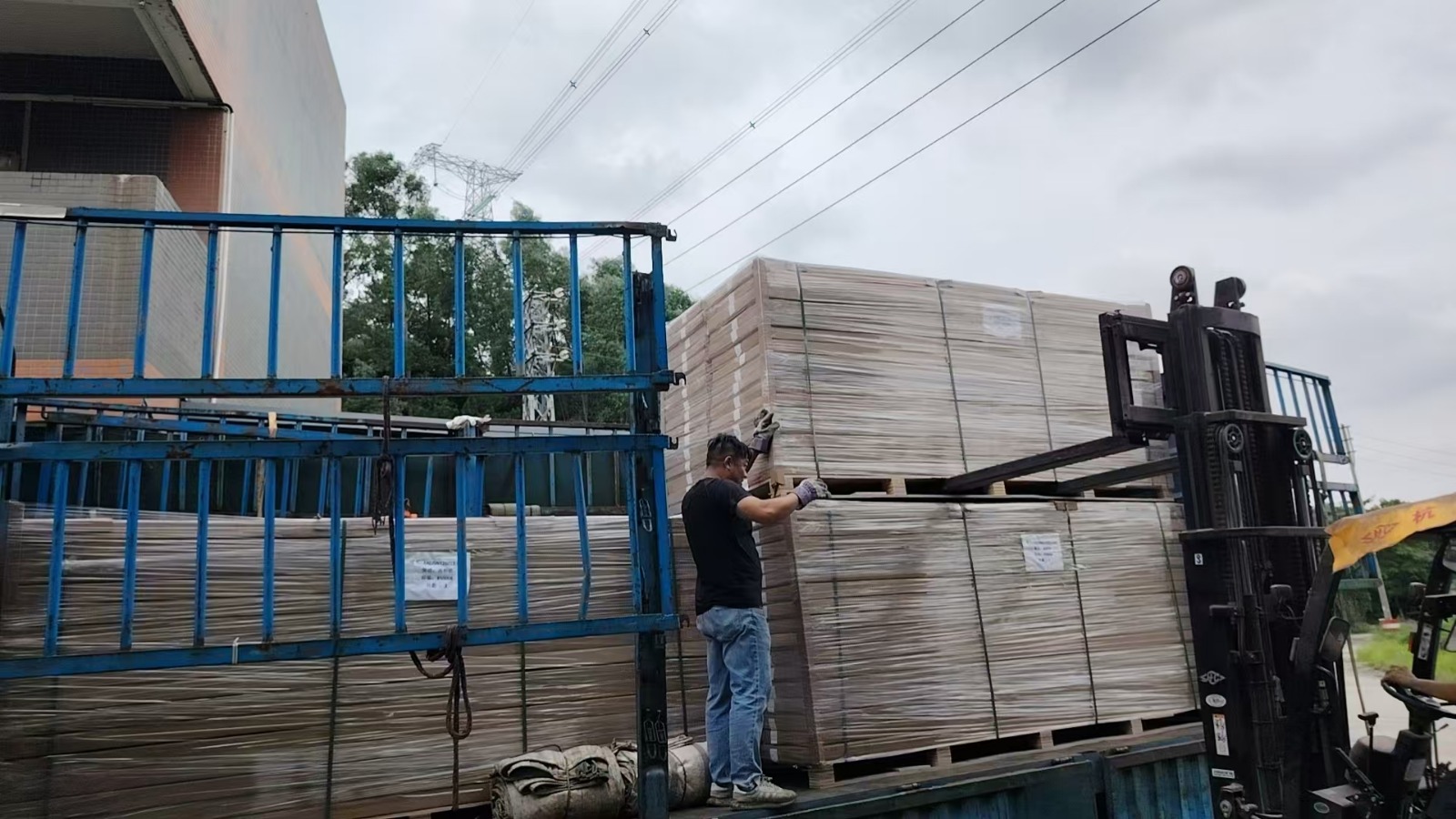
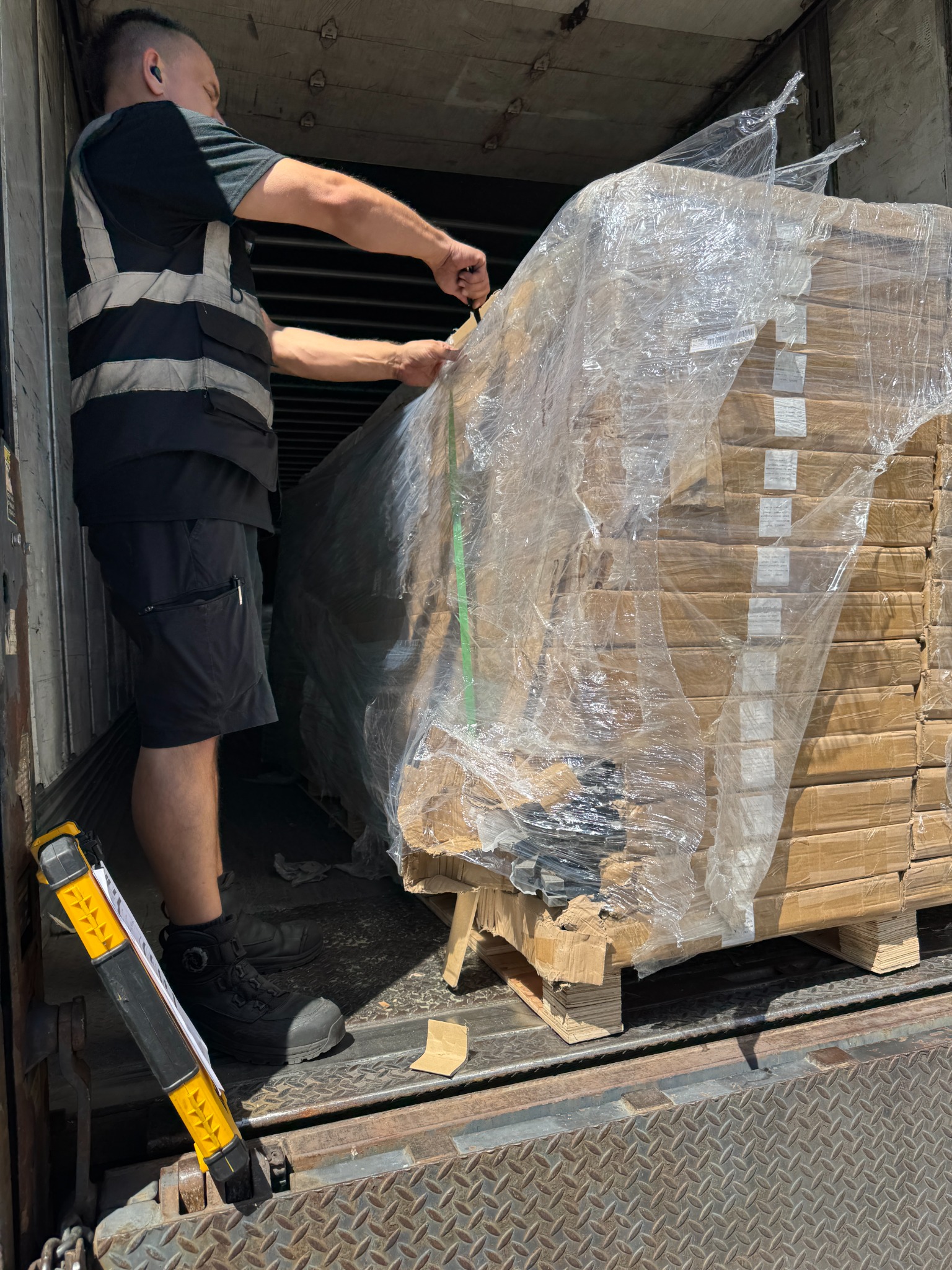
Original shipment video showing the truck crew handling oversized wall-panel inventory. Shown as documentation, not as lifting instructions.
Real AZ Wood Panels garage inventory in Phoenix Arizona with stacked boxed acoustic slat wood wall panels ready for local sale and installation
After unloading the truck: my home garage became the first AZ Wood Panels inventory space. Actual photo of boxed 10-foot acoustic slat wood wall panels stacked and ready for customers in Phoenix, Arizona.

Seeing all those boxes in the garage was a turning point. The product was no longer just an order from overseas—it was real inventory, taking up real space in my home, waiting for real customers. I had to think about storage, accessibility, safe stacking, and how to organize pickups while keeping the business moving.

What aspiring importers should plan before ordering

Discuss shipping and delivery terms, the vehicle and unloading method, pallet dimensions, accessibility, labor requirements, and safety with your freight provider before you pay for inventory. In my experience these practical details can change the real landed cost and make receiving panels more difficult than expected.

I also learned how to arrange additional people to help receive the panels. I share my own process for coordinating unloading help, along with my supplier contacts and the start-to-finish importing approach, in my private $500 one-on-one Google Meet consultation. Lifting and equipment decisions must be made by qualified professionals.

Installing the panels gave me confidence in the product.

We installed around ten panels in our house, and the result looked amazing. I then asked family members whether they'd like similar walls. A few did, and I helped with installations alongside a friend. Seeing the panels in real homes helped me understand what customers valued and what installation actually involved.

For our projects, cutting through felt between the slats was relatively straightforward with a sharp utility knife. Cutting through wood or MDF slats required suitable power tools; we used saws for crosscuts and a table saw where a lengthwise cut crossed a slat. Safe handling, blade selection, manufacturer guidance, and support are especially important with full-length panels.
ACTUAL AZ WOOD PANELS PROJECTS

From a single accent wall to real customers’ homes

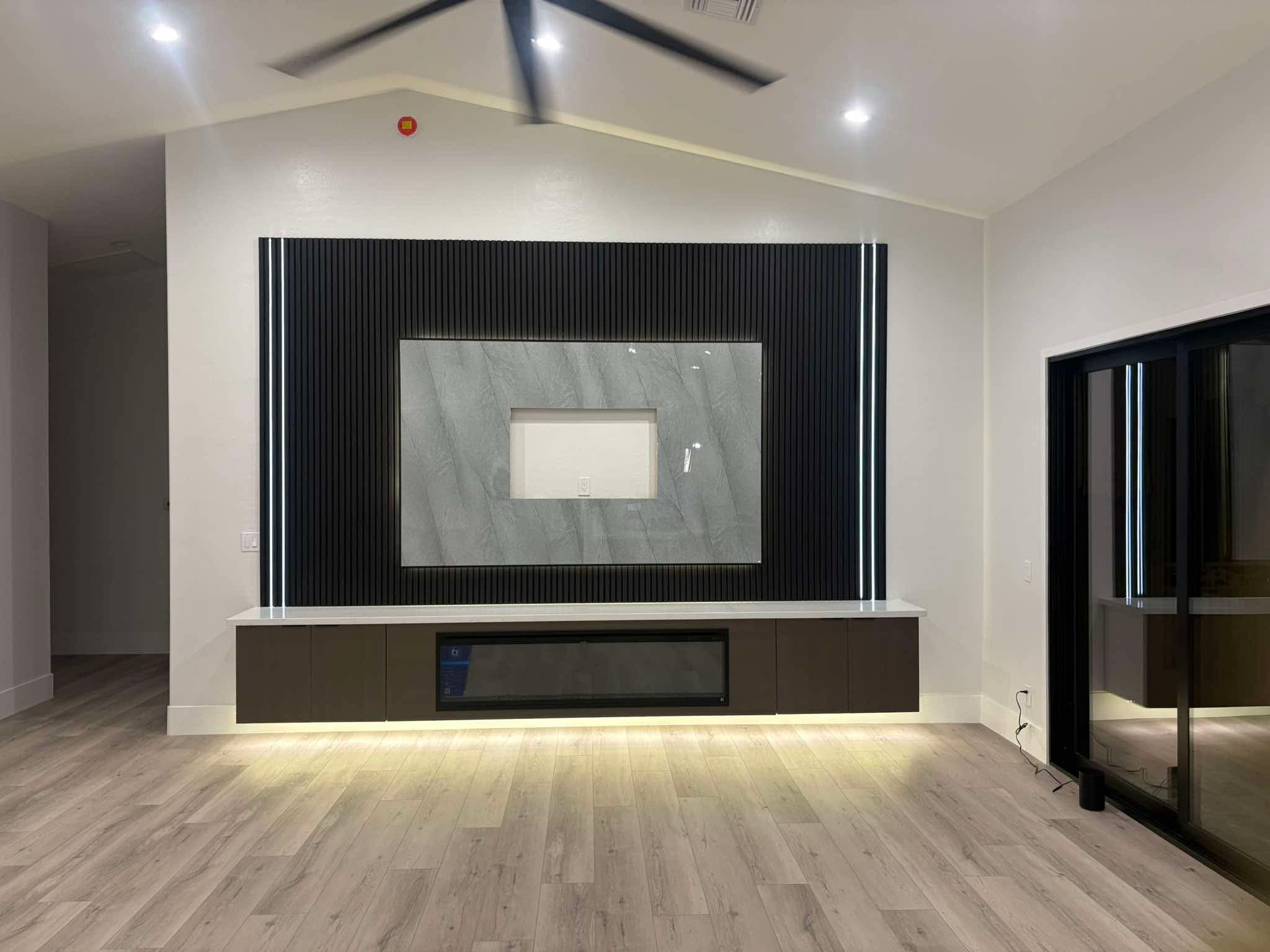
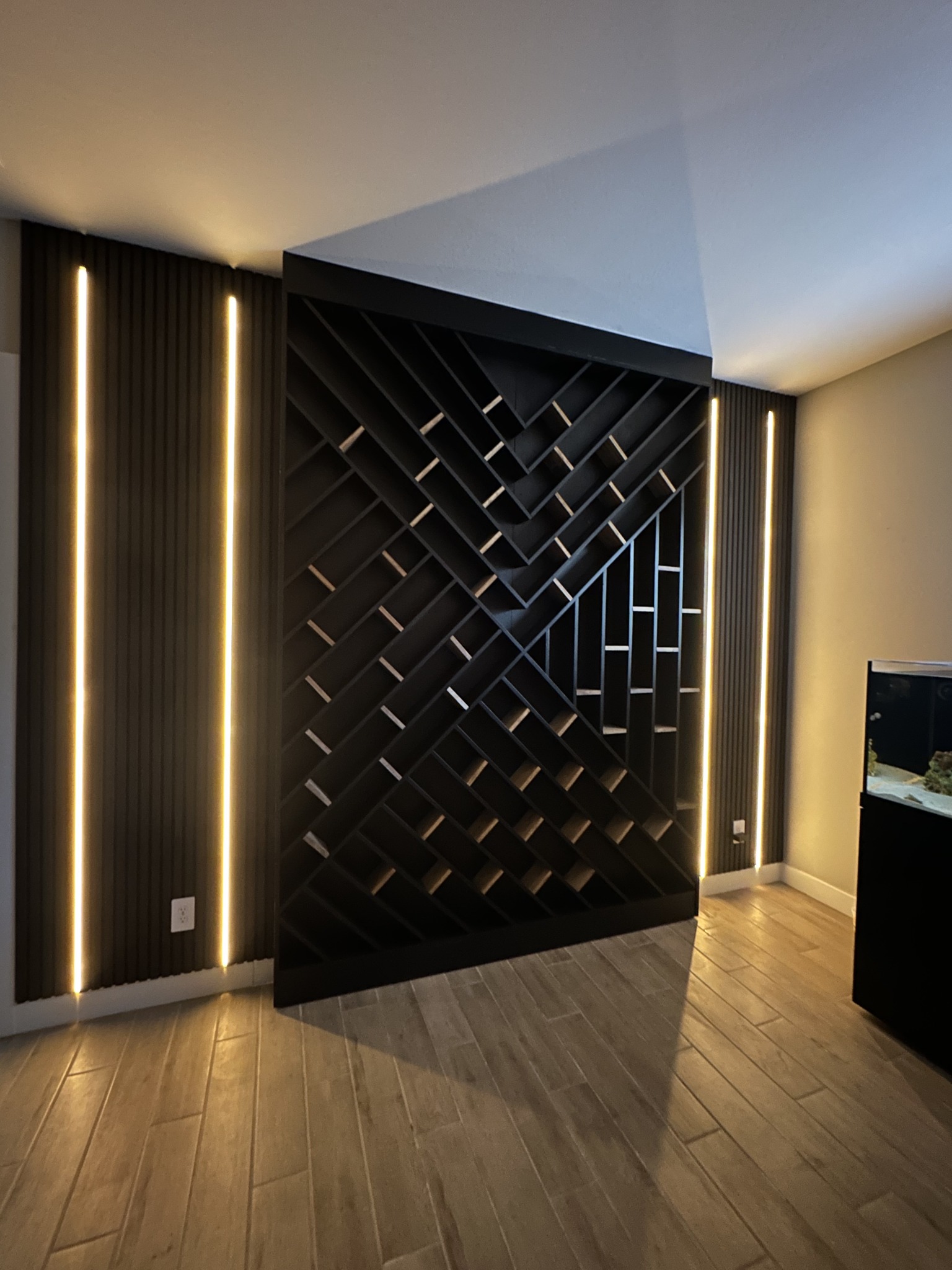
These five photographs show real wall-panel projects completed by AZ Wood Panels in the Phoenix area. Unlike illustrative renders, they document actual installations. They are examples of finished projects, not independent performance tests of competing products.

Black acoustic slat wood wall panels surrounding a custom television and fireplace media feature wall
TV and fireplace feature wall — black acoustic slat wood wall panels with integrated lighting and a floating media cabinet.
Black acoustic slat wood wall panels framing a geometric room divider with built-in shelving and warm vertical lights
Custom room divider — black acoustic slat wood wall panels alongside geometric shelving and LED lighting.
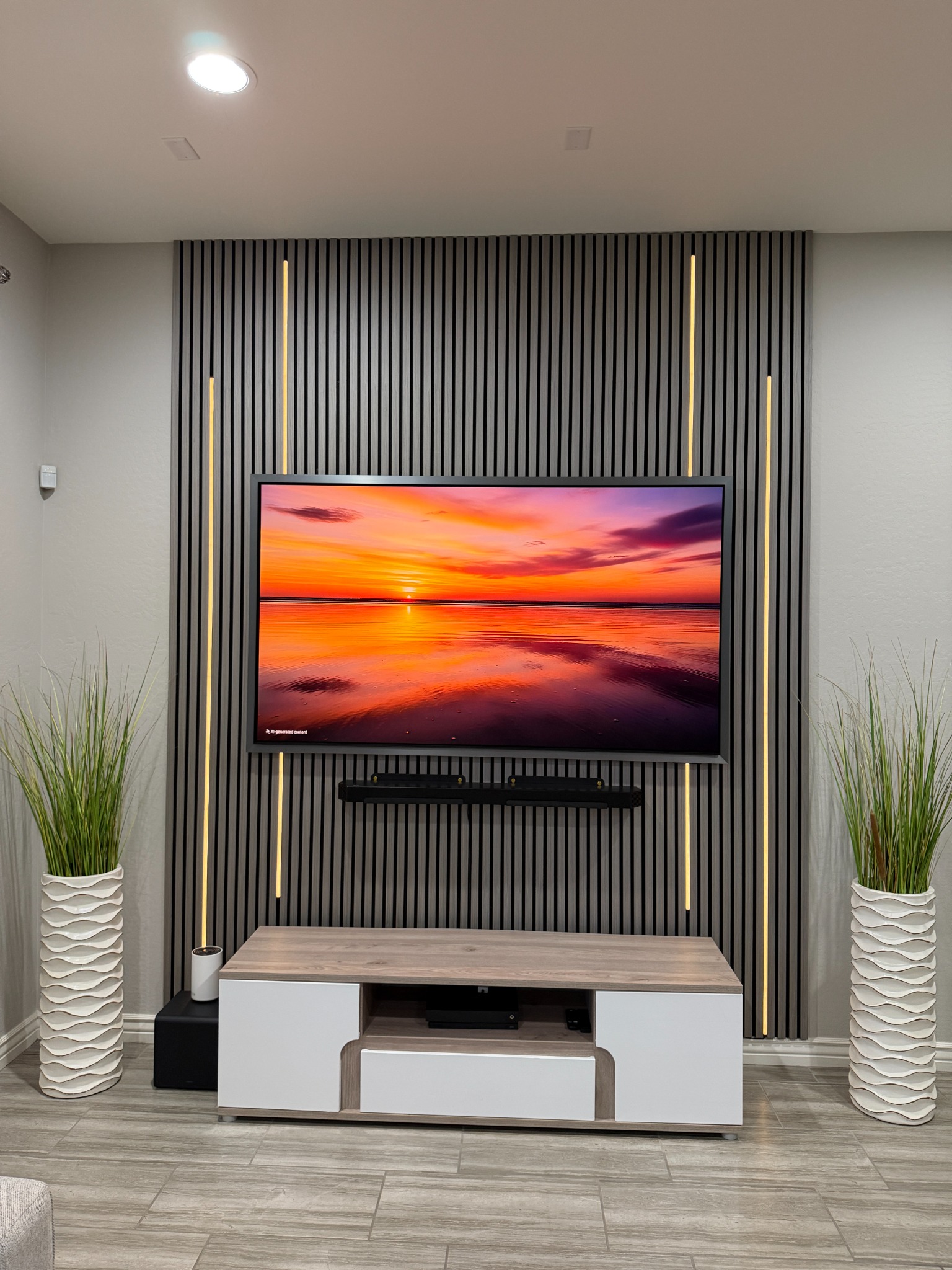
Charcoal acoustic slat wood wall panels used for a TV accent wall with vertical LED light strips
TV accent wall — charcoal acoustic slat wood wall panels with warm LED lighting.
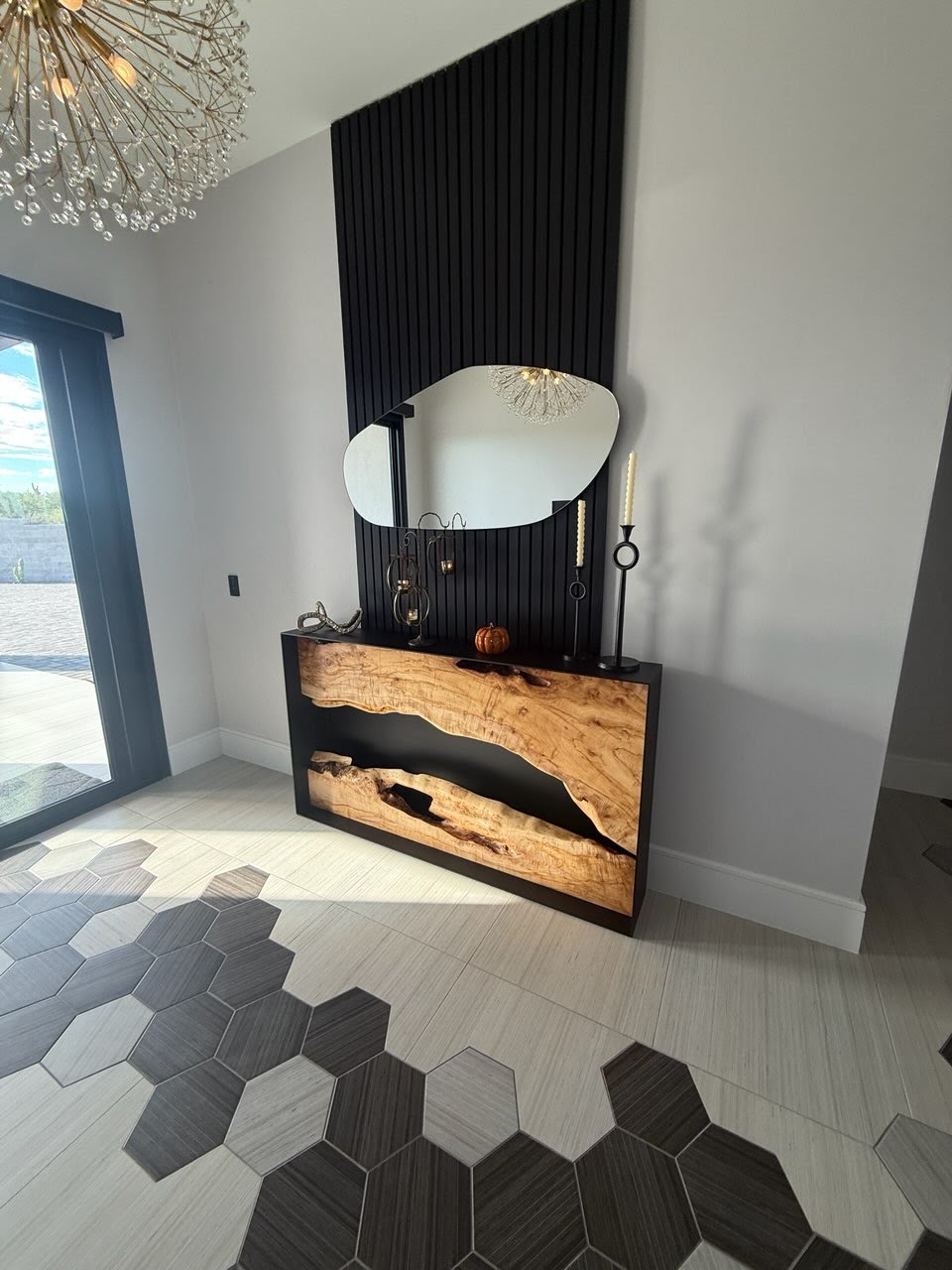
Black acoustic slat wood wall panels on an entryway accent wall above a natural wood console and mirror
Entryway accent wall — black acoustic slat wood wall panels, organic mirror and a statement console.
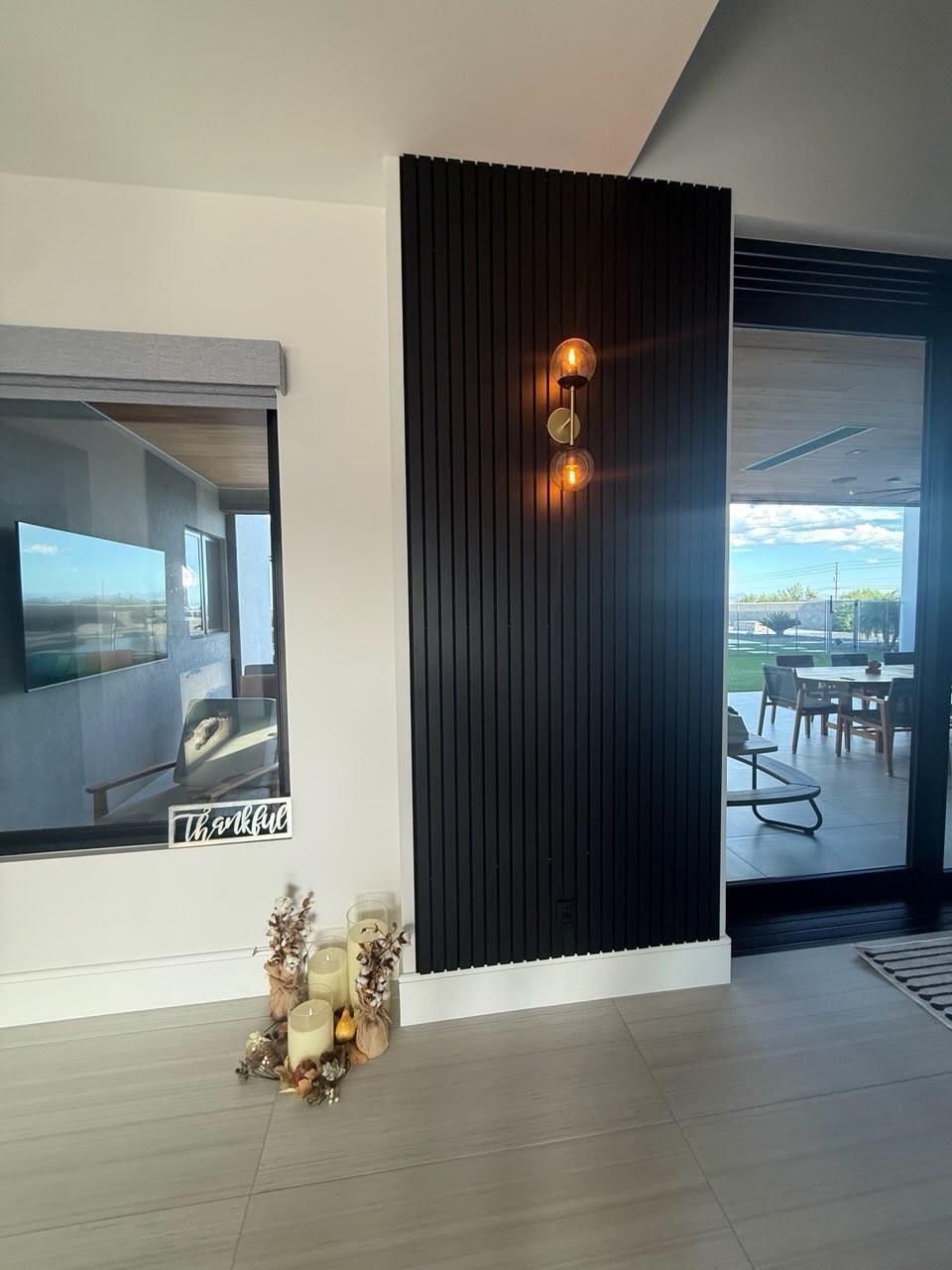
Black acoustic slat wood wall panels installed on a tall hallway feature wall with a warm decorative wall sconce
Hallway feature wall — black acoustic slat wood wall panels with a warm wall sconce.

Original project photos supplied by the AZ Wood Panels founder. The founder owns the featured business.

76 panels sold in 48 hours.

A few weeks later, I listed the available Natural Oak panels on Facebook Marketplace. I wasn't running an established store, and I had no idea how quickly the inventory might move. My goal was simply to sell the extras and see what happened.

We sold 76 panels within 48 hours of the listing. That was the moment I stopped thinking of the shipment as a one-off home improvement purchase and started thinking like a business owner. People had shown genuine demand by buying the product.

From an experiment to AZ Wood Panels.

I went back to the factory and began placing additional orders. The business eventually became AZ Wood Panels, a Phoenix-based supplier of large acoustic slat wall panels and other wall-panel products.

Every shipment I've purchased to date has sold out, and I'm now waiting for my largest shipment yet: approximately 1,035 panels in a full container. That shipment is pending at the time of this account; it should not be interpreted as already delivered or sold.

It's a long way from simply wanting ten panels for one wall.

From selling panels out of my garage to offering installation services

When I started AZ Wood Panels, I was running the business from my home garage in Phoenix. I was focused on importing and selling the panels, but something important happened when a local small contractor found my business through Google.

He came to my house and bought a few panels for a project he was working on for one of his clients. That was how we first met. We exchanged contact information, stayed in touch, and eventually began working together.

That relationship helped us offer something customers had been asking for: help getting their new acoustic slat wood wall panels installed. Rather than simply selling panels and leaving homeowners to find a contractor on their own, I now work with a local installation partner to help coordinate quotes.

How our wall-panel installation quotes work today

  1. A customer contacts AZ Wood Panels and sends me a photo of the empty wall they want to upgrade.
  2. I share the wall photo and project details with our local installation partner so he can prepare an installation quote.
  3. I combine the panel pricing with the proposed installation cost and send the customer an estimate to review.
  4. If the customer wants to move forward, we coordinate the next steps for their wall-panel project.

That simple workflow makes it easier to answer a question I hear often: “How much will the panels and installation cost together?” Actual installation prices vary with wall dimensions, electrical or lighting work, site conditions, and the agreed scope.

Why being discoverable on Google mattered

This partnership also taught me a marketing lesson: a business website does more than attract retail customers. It can introduce you to local contractors, installers, and potential partners. In my case, a contractor told me he found AZ Wood Panels on Google and that connection became a practical part of how the business serves customers.

If I were starting again, I would prioritize a clear website, accurate product pages, useful local service information, and a well-maintained Google Business Profile. I would also evaluate Google Ads as a separate paid channel for generating relevant leads. Organic search visibility (SEO) and paid Google Ads are not the same thing, and this particular contractor introduction does not establish which Google feature brought him to the business.

My takeaway: sourcing a good product was only the beginning. Making the business easy to find and building relationships with local professionals helped turn inventory in my garage into a more complete product-and-installation offering.

REAL BUSINESS NUMBERS · WHAT THEY DO AND DO NOT MEAN

Revenue is not profit. Here is how I think about the economics.

We have now reached $100,000 in cumulative sales revenue, according to my latest business records. This is a milestone I am reporting as the founder of AZ Wood Panels. An earlier payment-settlement export, combined with estimated Zelle transactions, did not independently establish the full amount; the newly reached total has not yet been independently reconciled by FoxyPick. This is a real operating business with physical inventory, genuine customers and completed installations—not a hypothetical online-business example. Revenue is not net profit.

I maintain actual transaction and settlement records for the business and can show selected, appropriately redacted financial evidence during a private session. In my paid one-on-one founder consultation, I can walk through selected supporting business data and explain the real-world economics, while protecting sensitive customer information, bank details, and confidential supplier terms. My results are individual and do not predict what another business will earn.

My business has processed sales through online payments as well as direct customer payments, including Zelle. I have financial settlement records and estimate roughly $20,000 of additional Zelle sales, but a complete profit-and-loss reconciliation has not yet been published. A processor payout does not equal revenue, and revenue does not equal take-home profit.

01Customer sales

Count completed sales and subtract refunds. Keep taxes and internal transfers separate.

02Landed inventory cost

Include manufacturing, freight, duties, customs, and receiving expenses.

03Business expenses

Deduct payment fees, storage, advertising, delivery, labor, and other operating costs.

04Actual profit

Reconcile inventory sold, remaining inventory, and the period covered before claiming profit.

Financial figures and dates will be updated when reconciled against the underlying records. No earnings are guaranteed for anyone starting a similar business.

PRACTICAL GUIDE · ALIBABA IMPORTING

How to start a profitable business with Alibaba: what my experience taught me

Before you order, do the math. Use the free Alibaba import landed-cost calculator to estimate product cost, overseas freight, customs duties, receiving expenses, resale margin and break-even pricing using your own quotes.

People searching for how to start a profitable business importing from China often want a repeatable formula. I cannot promise that formula: my experience shows how to test an opportunity, but profitability depends on costs, local demand, execution, and inventory risk. Here is the practical sequence I followed when starting a business using Alibaba.

  1. Find an actual customer problem. For us, it was the high price of 10-foot acoustic slat wood wall panels for our own house.
  2. Research manufacturers in China. I contacted multiple factories through Alibaba, compared their panel styles, and found a suitable finish. A new importer should independently verify supplier identity, request samples, and examine payment protections.
  3. Calculate the true imported cost. Include product price, international shipping, customs, duties, brokerage, local delivery, unloading labor, storage, breakage, and sales expenses—not just the factory quote.
  4. Test local demand before expanding. Our initial 100-panel order was risky. The first Marketplace sales provided encouraging evidence, but no first order is guaranteed to sell.
  5. Create a local sales channel. A clear website, relevant local SEO pages, and accurate Google Business Profile information can help customers and contractors discover the business. Google Ads is a separate paid option.
  6. Build a service network. A contractor discovered AZ Wood Panels on Google, purchased panels, and became an installation partner.
  7. Reinvest carefully. Reordering should be based on real sales, cash-flow needs, and the costs of holding unsold stock.

Is importing from China through Alibaba profitable?

It can be, but revenue is not profit. Importers need to subtract product and freight costs, customs fees, local operations, delivery, advertising, refunds, and labor. AZ Wood Panels has reached a founder-reported $100,000 in cumulative sales revenue, but that figure is not a claim about net earnings or what another entrepreneur will make.

How much money do you need to start importing from China?

There is no universal startup amount. Minimum order quantities, dimensions, shipping arrangements, duties, equipment and storage needs all affect required capital. In my case, the supplier minimum was 100 panels; other factories and products may have different terms. Plan for working capital and possible delays or unsold inventory.

Can you start a wall-panel business in your own city?

You can research the opportunity in your market, but first assess local competition, customer budgets, permits and installation requirements, storage and delivery logistics, and whether manufacturers can meet your needs. My one-on-one importing consultation shares my firsthand process and supplier contacts, not a promise of results.

What I learned—and what I'd tell a new importer.

My first lesson is to pay attention to problems you personally encounter. We discovered the price gap because we were customers looking for something specific. The second lesson is to test whether anyone else actually wants the product. Our Marketplace sale was a demand signal, but later repeat orders were what made this feel like a real business.

The third lesson is that a strong markup is not the same thing as profit. Inventory, freight, customs duties, damage, storage, marketing, transaction fees, delivery, taxes, and unsold stock all affect cash flow and margins. We plan to add a reconciled cost breakdown after validating the underlying figures.

Finally, setbacks from earlier business attempts were not wasted. I'd spent years looking for a viable idea, and this one began with a decision to try something small and learn from the outcome—even if the first order didn't feel small at the time.

EXPLORE THE PRODUCT

Considering acoustic slat wall panels?

Our separate wood accent wall panel buying guide compares materials, installation considerations, and budget tradeoffs. It draws on documented product information and clearly distinguishes founder experience from independent product research.

Explore FoxyPick's wall fit tools →

WHAT COMES NEXT

More behind-the-business reporting

Planned follow-ups cover supplier questions, importing logistics, how the website was built, first customer acquisition, and an accurate breakdown of costs versus revenue. These details will be added when supported by invoices, dates, and other records—rather than guessed at for a dramatic headline.

Editorial disclosure: FoxyPick's featured founder owns AZ Wood Panels, linked above. The company could benefit from referrals generated by this article. This is a founder's experience, not a neutral endorsement or comparative ranking. Individual sourcing and sales results are not typical or guaranteed.

← Explore all Foxy Stories