
Distinguishes reflected and direct sound and explains absorptive treatment.
FOXYPICK HOME / WALL PANELS / THE NOISE PROBLEM
Do Acoustic Slat Wall Panels Soundproof a Room? Echo vs. Noise Explained
Will acoustic slat wall panels stop noise from neighbors or make a room less echoey? Learn NRC vs STC, what felt-backed slats can and cannot do, and what to check first.
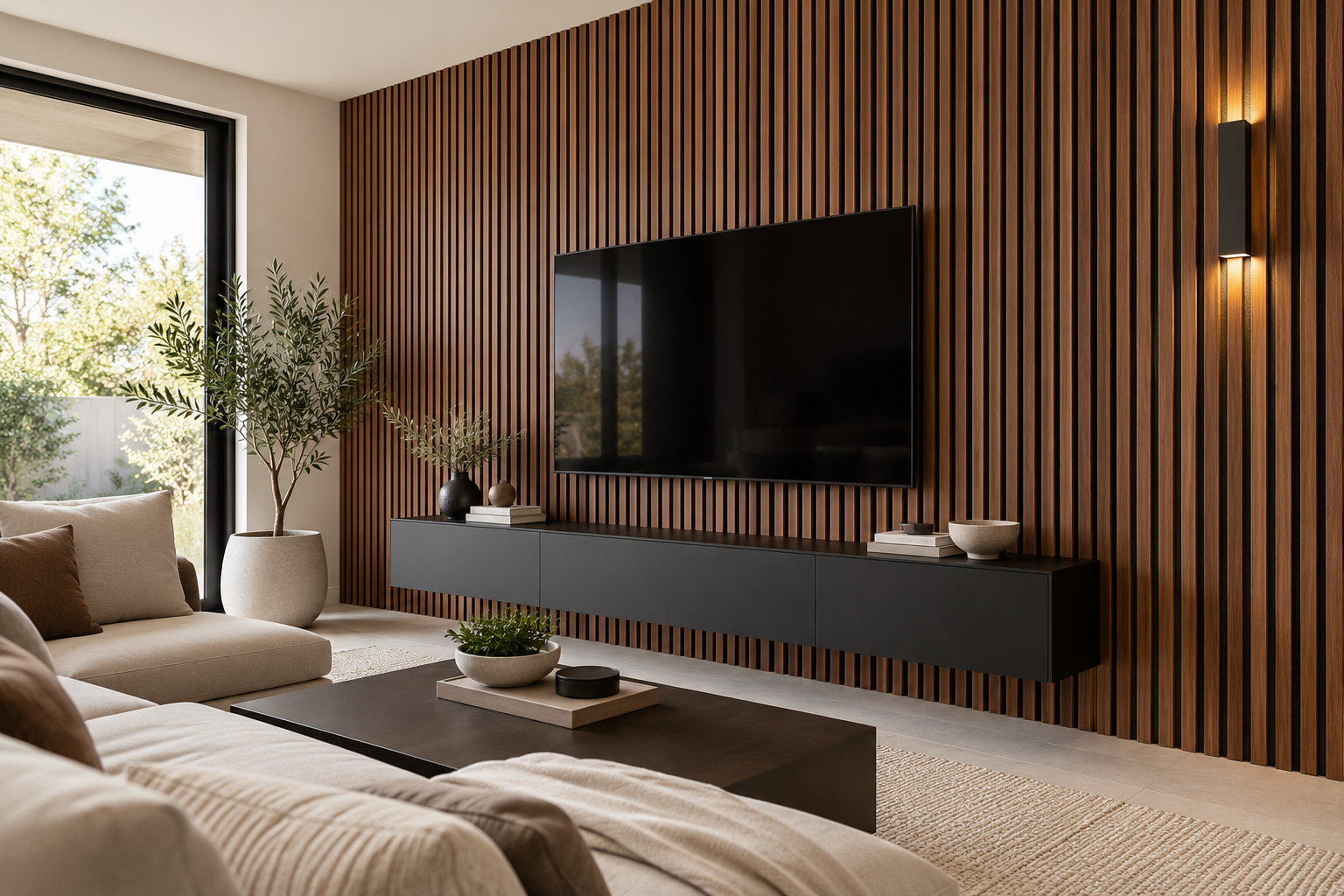
THE ANSWER FIRST
What homeowners need to know.
Not by themselves. Decorative slats on felt are usually considered a room-finish or absorption solution, not a verified sound-isolation wall assembly. If your problem is echo inside a room, a product with tested sound-absorption data may help. If your problem is hearing neighbors, television or traffic through a wall, you need to investigate the full wall, openings, flanking paths and tested sound-transmission performance.
THE TWO VERY DIFFERENT PROBLEMS
Are you fighting echo or noise coming through a wall?
| What you notice | The likely problem | What to investigate first |
|---|---|---|
| A living room sounds hollow or speech echoes | Reflected sound within the same room | Soft furnishings, acoustic treatment, room layout and verified absorption data |
| TV dialogue is hard to understand because the room is reverberant | Room reflections, placement and setup | Speaker positioning and tested acoustic treatment appropriate to the frequencies involved |
| You can clearly hear voices from the next bedroom | Sound passing through an assembly | Doors and gaps, flanking routes, seals and a rated wall/door assembly |
| Street noise comes through windows or the wall | Airborne noise transmission | Window/door seals, glazing, ducts, facade pathways and appropriate isolation strategy |
A quieter-sounding room and a room that blocks a neighbor's noise are separate objectives. FoxyPick did not run independent acoustic lab tests on the panels shown.
EXPLANATION WITHOUT THE HYPESTEP 01 STEP 02 STEP 03 STEP 04 STEP 05
Understand the real trade-offs.
The simple difference: absorption is not isolation
Sound absorption reduces energy reflected within the same space; sound isolation reduces sound passing from one space to another. This distinction matters because a pretty wood finish and an effective sound barrier solve different problems.
OSHA's noise-control reference explains that absorptive panels can reduce reflected sound without removing direct sound. For walls between rooms, consult the rated construction assembly, not just the appearance of a decorative face.
Understand the labels: NRC versus STC
Noise Reduction Coefficient (NRC) relates to absorption. Sound Transmission Class (STC) is a single-number description of transmission loss through a tested assembly. These figures are not interchangeable, and neither can be copied from a different installation arrangement.
A slat panel tested with an air gap, specialized insulation or separate mounting may behave differently when installed flush to drywall. Ask for the exact test report and mounting details. If no report exists, treat acoustic performance as an unverified claim rather than a specification.
What should you buy for an echoey room?
Start by identifying whether the room has too many hard reflective surfaces and whether the sound issue happens inside that same space. Curtains, rugs, upholstered furniture and purpose-designed absorbers are alternatives worth comparing before covering an entire wall.
If you prefer a slatted look, shortlist panels with relevant absorption testing. Consider where you place them, exposed surface area, fire performance, mounting, maintenance and aesthetics. The best finish may not be the most efficient acoustic treatment.
What if the noise is coming from a neighbor?
Do not order decorative slats expecting to block a next-door television. Check gaps around doors, plumbing penetrations, air registers and windows first. The improvement may require a specialist to diagnose transmission paths or design a rated wall/door upgrade.
Always discuss life-safety, electrical devices and building-code requirements before adding layers, sealing penetrations or altering walls. FoxyPick is not providing an engineered sound-isolation design.
Avoid these five buying mistakes
First, confusing an NRC figure with a soundproofing claim. Second, assuming any felt is a high-performance absorber. Third, treating a tested assembly result as a standalone panel rating. Fourth, buying before identifying the noise path. Fifth, ignoring trim, wall dimensions, outlet clearances, local installation codes and delivery.
An attractive slat wall can still be the right purchase if your objective is appearance. The important thing is making the decision for the benefit it can actually provide.
FOXYPICK DECISION HELPER
Which problem are you trying to solve?
Explore a transparent starting point, then check the full research and your actual product requirements.
Qualitative guide only. Not a measured acoustic recommendation.
CHECK THE ORIGINAL MATERIALOSHA: Noise and reflected sound ↗ Johns Manville: Acoustics and ratings ↗ WELL: Sound absorption ↗
Evidence, not manufactured testing.
The facts and formulas above are grounded in the linked technical material. FoxyPick has not performed comparative laboratory testing of all the products discussed.
Explains STC for assemblies and NRC for exposed absorption.
Explains why absorbent surfaces can improve reverberation.
QUESTIONS WORTH ANSWERING
Frequently asked before buying.
Will acoustic panels stop a neighbor's TV?
Not as an assured result. Noise isolation depends on tested wall/door assemblies and leakage paths. Decorative panels alone are not a substitute for evaluating the full construction.
Is felt backing the same as soundproof insulation?
No. Felt can be one component in an absorbing finish, but its performance depends on the exact tested product and installation.
Does a higher NRC mean more soundproofing?
No. NRC addresses absorption, not the transmission loss of an assembled wall.
Do I need to cover every wall?
Not necessarily. The amount and placement of treatment depend on the room and problem; ask for measured or modeled guidance for serious acoustic issues.
CONTINUE YOUR RESEARCH
Your next useful step.
Disclosure: FoxyPick may earn commissions from eligible affiliate links elsewhere on the site. The founder operates a Phoenix-area wall panel business. These connections do not make untested product performance claims true. See disclosures.
WE RESEARCH. YOU DECIDE.
Good decisions begin with the right question.
More home-upgrade problems, answered with practical math, evidence and honest limitations.
See all problem solvers ↗