
Model-specific product features, connectors, mounting and ingress protection claims.
FOXYPICK HOME / PERMANENT LIGHTING / THE HIDDEN HARDWARE QUESTION
Do Permanent Outdoor Lights Need Tracks? DIY Clips vs Concealed Channels
Should permanent outdoor lights go in aluminum tracks? Compare DIY clip mounting, concealed channels, heat, compatibility, repairs and real installed project costs.
THE ANSWER FIRST
What homeowners need to know.
No—not every permanent outdoor lighting system requires a separate track. Some kits are designed for their supplied clips or approved adhesive and mounting hardware. Tracks or channels may produce a more integrated daytime look and improve cable management, but they also change the installation, access, component spacing and total cost. The correct answer depends on your exact light model, manufacturer instructions and roofline.
LOOK GOOD WITH THE LIGHTS OFF
The real decision is about daylight appearance and service
| Mounting approach | Potential advantage | What to verify |
|---|---|---|
| Manufacturer-approved clips or brackets | Lower extra-material cost and an accessible DIY route | Fastener ratings, surfaces, warranty, clean wire routing, safe access |
| Compatible aftermarket track/channel | Concealed cables and a deliberate finished appearance | Puck dimensions, hole positions, drainage, temperature, maintenance and warranty |
| Dealer-integrated concealed track | Coordinated installed finish and one installer contact | Labor/service commitments, replacement components, track material and documented quote |
Original cost illustration (not market pricing): 120 ft × ($9 of lights + $4 of track + $11 labor) + $200 in fixed extras = $3,080 before tax, waste and unknown work.
EXPLANATION WITHOUT THE HYPESTEP 01 STEP 02 STEP 03 STEP 04 STEP 05
Understand the real trade-offs.
Start with your specific light model—not a generic track listing
Permanent lights use different puck sizes, cable geometry, connectors and spacing. An aluminum channel described as 'Govee compatible' may fit one generation and not another. Before ordering, verify exact model number, cable dimensions, electrical instructions and the manufacturer's allowances for cutting or extending.
For example, Govee's Permanent Outdoor Lights 2 Pro page describes cut/connect customization for those specific models; that statement cannot be generalized to every Govee light kit or every connector configuration. Compare the published manual to what your track supplier promises.
The daytime test: look up at the eaves when the lights are off
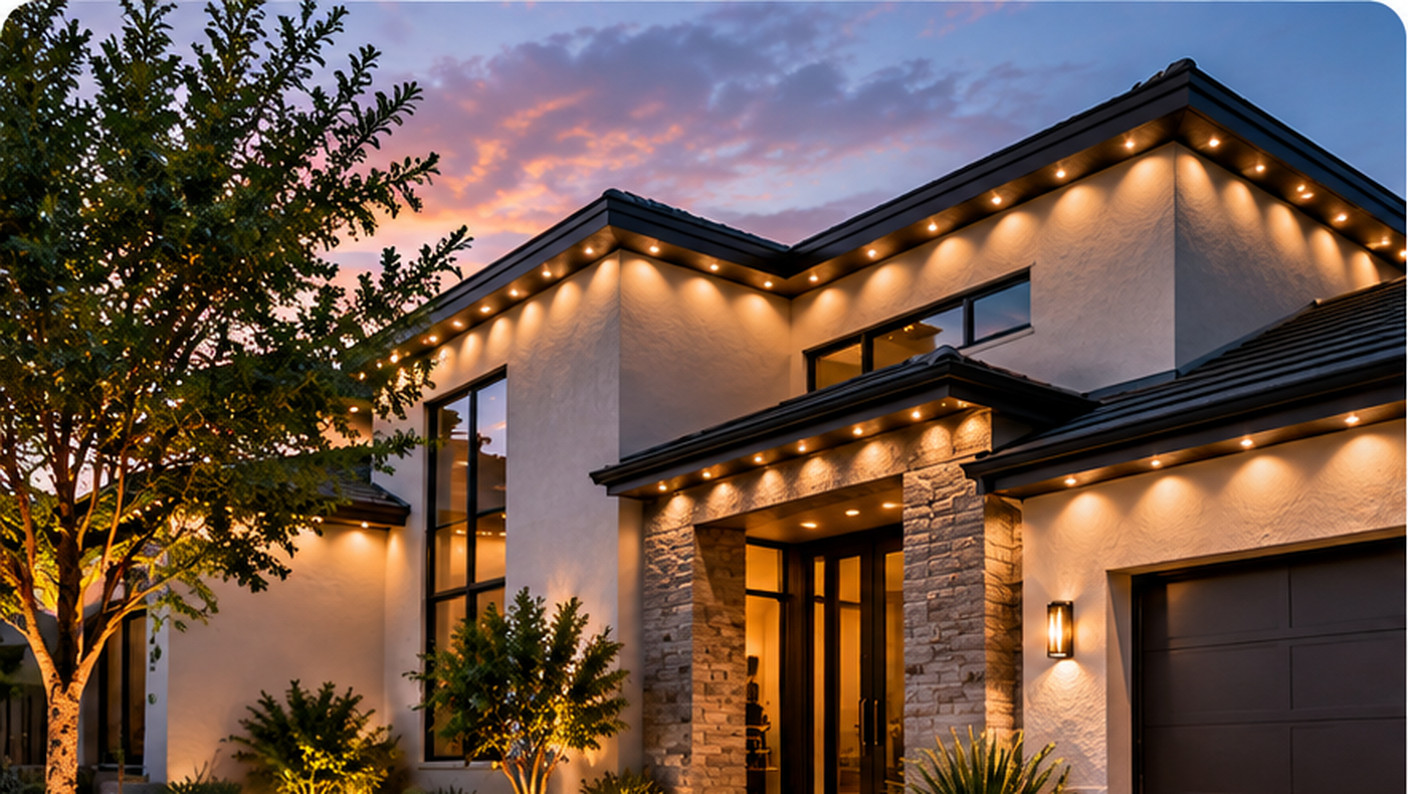
If a house has clean white fascia, exposed black cables or uneven clips may be the part you notice most. Ask for a real daylight installation photo, not only an illuminated night shot. A track can help lines look organized, but only when mounting and transitions are carefully planned.
Check trim color, fascia or soffit shape, corner transitions, downspouts and roof-level changes. Separate a straight-run price from the price of finishing corners, branches and power transitions.
Heat, rain and material choices are system questions
IP ingress ratings address intrusion by dust or water under specified tests; they do not tell you the operating-temperature limits of a controller, power adapter, cable or track. In hot climates, ask for each component's manufacturer-rated operating conditions and an installation location within those limits.
Metal tracks may have different thermal expansion, finish and mounting considerations than polymers. Avoid assuming aluminum automatically makes a mismatched light kit safe or that a weather-resistant puck means its power adapter belongs in direct sun.
Repairability matters more than a perfect photo
Ask how to replace one failed light in the middle of a run, how to access connections, how to clean and inspect the track and whether removing one section will damage the surrounding finish. An inaccessible hidden channel can make later maintenance expensive.
Have the seller explain replacement hardware, installation labor warranty and spare parts availability. A professional quote should say who supplies and services lights, tracks, control hardware and power supplies.
Calculate the cost of a whole roofline
Measured feet × (kit per foot + channel per foot + labor per foot) + fixed extras is a useful starting equation. Remember that kit packaging length is not necessarily the same as your traced roofline, and corner transitions, extensions, waste, tax or permitted electrical work may add costs.
Use the FoxyPick roofline calculator with actual written quotes. Avoid copying a national 'average installation price' into your budget without checking scope and geography.
FOXYPICK DECISION HELPER
What matters most for your home?
Explore a transparent starting point, then check the full research and your actual product requirements.
Use this alongside the exact product installation manual.
CHECK THE ORIGINAL MATERIALGovee: Permanent Outdoor Lights 2 Pro ↗ FoxyPick: Roofline cost estimator ↗
Evidence, not manufactured testing.
The facts and formulas above are grounded in the linked technical material. FoxyPick has not performed comparative laboratory testing of all the products discussed.
User-entered arithmetic and a privately downloadable estimate.
QUESTIONS WORTH ANSWERING
Frequently asked before buying.
Is a track necessary for a professional result?
Not always. The expected daylight appearance, mounting material and cable-routing plan are more useful than the presence or absence of a channel alone.
Can I use any track with Govee lights?
No. Verify exact product generation, LED dimensions, pitch, connector clearance and the maker's installation instructions.
Will tracks make lights last longer?
Not automatically. Durability depends on components, temperature, water paths, fasteners and service conditions; no endurance test is claimed here.
Should I choose aluminum or PVC?
Evaluate local exposure, supplier ratings, mechanical fit, UV resistance, thermal expansion, appearance and cost for the actual system. Do not select by one material label alone.
CONTINUE YOUR RESEARCH
Your next useful step.
Disclosure: FoxyPick may earn commissions from eligible affiliate links elsewhere on the site. The founder operates a Phoenix-area wall panel business. These connections do not make untested product performance claims true. See disclosures.
WE RESEARCH. YOU DECIDE.
Good decisions begin with the right question.
More home-upgrade problems, answered with practical math, evidence and honest limitations.
See all problem solvers ↗